Advanced Typography_Task 2: Key Artwork & Collateral

15 October 2024 - 11 November 2024
CHONG CHENG TAO (0371072)
Advanced Typography | Bachelor of Design in Creative Media | Taylor's
University
Task 2: Key Artwork
List
LECTURES
Week 5
AdTypo_5_Preception And Organisation
Perception & Organisation
Perception is “the way in which something isregarded, understood, or
interpreted.”
Preception in typography deals with the visual navigation and interpretation
of a reader via contarst, form and organisation of the content.
Contrast
There is several methods to create contrast (by Rudi Ruegg):
- Light/ Bold
- Condense/ Extended
- Organic/ Machined
- Roman/ Italic
- Small/ Large
- Negative/ Positive
- Serif/ Sans serif
- Ornate/ Simple
- Red/ Blue
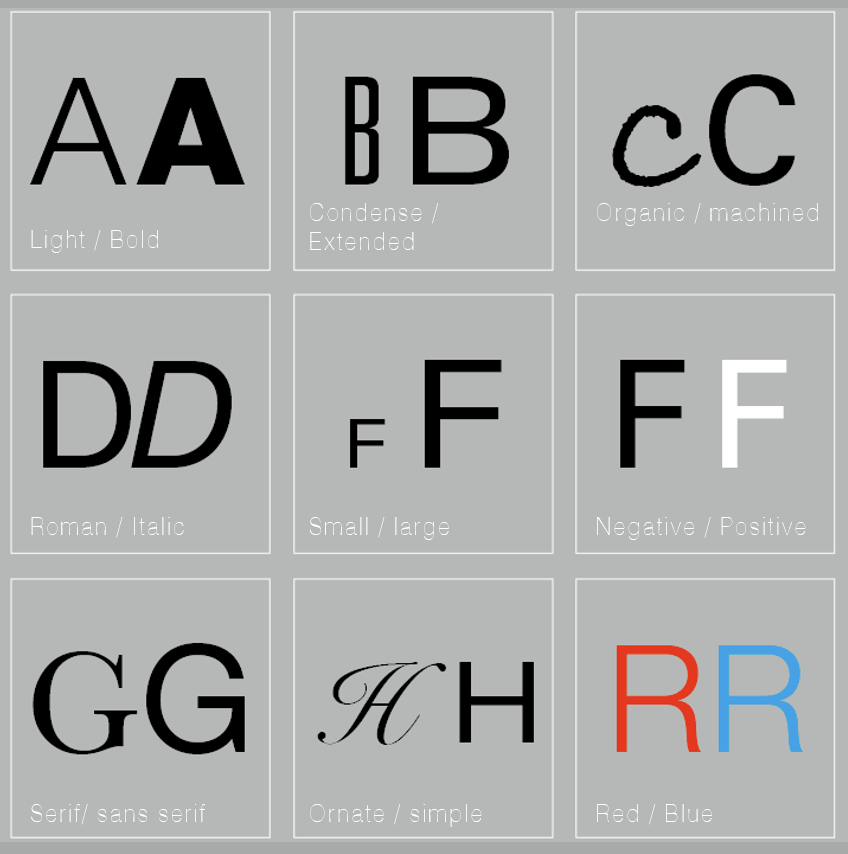
Fig 1.5.1 Type of Contrast (by Rudi Ruegg)
Besides, Carl Dair adds two more principle:
1) Size
Contrast in size provides a point for reader’s attention to be drawn. For
instance, we will obviously see the big letter first before the small. Some
commomn use of size is the make the title or heading bigger to be more
noticible.
2) Weight
Weight is bold type can stand out in the middle of lighter type of the same
style. Besides, rules, spots, squares are used as “heavy area” for a visual
attraction or emphasis.
3) Contrast of Form
Contrast of form is the distinction between letters. Example of forms:
Capital letter, lowercase letter, roman letter, italic, condensed and
expanded.
4) Contarst of Structure
Structure means the different letterforms of different kinds of typefaces.
Example of structure: monoline sans serif, traditional serif, italic and
blackletter.
5) Contarst of Texture
Texture is the way the lines of type look as a whole up close and from a
distance. This depends partly on the letterforms and the arrangement.
6) Contarst of Direction
Contrast of direction is the opposition between vertical, horizontal, and
the angles in between. Mixing wide blocks of long lines with tall columns of
short line can create contrast roo.
7) Contrast of Color
A second color is often less emphatic in values than plain black on white.
Therefore it is important to give thought to which element needs to be
emphasized and to pay attention to the tonal values of the colors that
are used. Thus, it is important to evaluate which elements that need to be
pay attention.

Fig 1.5.2 Type of Contrast (by Carl Dair)
Form
For refers to the overall look and feel of the elements that make up the
typographic composition. It is the part that plays a role in visual impact and
first impressions.
A good form in typography tends to be visually intriguing to the eye; it leads
the eye from point to point, it entertains the mind and is most often
memorable.
Typography can be seen in 2 function: Represent a concept and a visual form
When a typeface is perceived as a form, it no longer reads as a letter.
Instead, it has been manipulated by distortion, texture, enlargement, and has
been extruded into a space.

Examples of Form

Fig 1.5.3 Form with good communication
Organisation and Gesalt
Gestalt theory emphasizes that the whole of anything is greater than its
parts as we experience things as unified whole. Although each element may
be functional at an elemental level, the overall form is till greater than
the sum of its part.

Fig 1.5.4 Gesalt Principles of Grouping
1) Law of Similarity
It states that humans tend to perceive elements that are close to each
other as belonging together, spatial arrangement of visual elements
influences our perspective of their relationship and grouping
2) Law of Proximity
It states that elements that are close together tend to be perceived as a
unified group whereas items further apart are less likely to be grouped
together.
3) The Law of Closure
It refers to the mind’s tendency to see complete figures or forms
even if a picture is incomplete, partially hidden by other objects, or if
part of the information needed to make a complete picture in our minds is
missing
4)Law of (Good) Continuation
It states that humans tend to perceive each of two or more objects as
different, singular, and uninterrupted object even when they intersect. The
alignment of the objects or forms plays a major role for this principle to
take effect.
5) Law of symmetry
It explains how humans perceive visual elements as balanced when they are
arranged in symmetrical or follow a predictable pattern.
INSTRUCTIONS
This is the Module Information Booklet for this module:
- Mindmap / Research
- Idea / Sketches
- Wordmark Aniamtion
- Expansion
- Collateral
- Final Submission
Mindmap / Research
Before the sketches, we are instructed to do a mindmap about ourself. We
will need to find keyword that represent ourself. It can be the present
"me", or a person I look forward to become.

Fig 2.1.1 Mindmap_About Me (16/10/2024, week 4)
Ideas / Sketches
1) Keyword: Expand. /Explore.
I’m a person eager for more creativity ideas in my life and sensitive on interpersonal relationship with others.
The spikes represent both of my personalities:
The spikes represent both of my personalities:
- Eager to find and experiment with different direction in my art.
- Sensitivity to interpersonal relationship. (Rose spine)

Fig 2.2.1 Sketch 1(22/10/2024, week 5)
2) Keyword: OVERSATURATED.
Inspired by Shoegaze music and topographic map. I try to capture the “dense”, “dreamy” and “oversaturated” feeling I get from Shoegaze music. Topographic map gives me the same feeling, but visually.

Fig 2.2.2 Creating thoughts_Sketch 2(22/10/2024, week 5)

3) Keyword: Growth. / Roots.
My creating process is like roots, it branches out and entangle together.

Fig 2.2.4 Sketch 3 (22/10/2024, week 5)


Fig 2.2.5 Key Artwork Sketches & Ideas (22/10/2024, week 5)
After the feedback session, I would like to continue the idea of
keyword "Explore". Mr. Vinod instructed me to develop more sketches with
different form stonger readability.
I try to use arrow as my main elements for the design. I'm satisfied with
the first version.

Fig 2.2.6 Key Artwork Ideas (29/10/2024, week 6)
Following is the refined version:

Fig 2.2.7 Final Wordmark Design (29/10/2024, week 6)
Wordmark with color palette:

Fig 2.2.8 Wordmark with Color Palette (29/10/2024, week 6)
Wordmark Animation
I try to utilize the "arrow" elements in the animation. These are my brief
idea:
- First wordmark (white) appear with the path animation.
- Color palette showcase.
- Second wordmark (blue) appear.

Fig 2.3.1 Wordmark Animation_First attempt (5/11/2024, week 7)

Fig 2.3.2 Wordmark Animation_Second attempt (11/11/2024, week 8)
In the second phrase of development, I try to use the expansion
element in the animation.
Expansion
My expansion of the wordmark will be the arrow symbol.

Fig 2.4.1 Wordmark expansion (5/11/2024, week 7)
I shift the color of one arrow to be green with dark blue.

Fig 2.4.2 Expansion pattern(5/11/2024, week 7)
Collateral
My main ideas for the brand identity will be a sport brand.
These are my ideas for the mockup:
- T-shirt (Compulsory)
- Totebag(Compulsory)
- Soda can
- Stickers

Fig 2.5.1 Mockup (5/11/2024, week 7)
Catch phrase:
- "LEADING DIRECTION, MOVING FORWARD"

- Grid 3: The design is not interesting enough.
- The overall designi is too clutter and lack of clear visual direction.

In this version, I try to:
- Apply more visual direction, by adjusting the placing of items and additional text.
- Gradient to create a modern vibe.
<back to top>
Final Submission
Wordmark

Fig 2.6.1 Black wordmark with white background (29/10/2024, week 6)

Fig 2.6.2 White wordmark with black background (29/10/2024, week 6)

Fig 2.6.3 Color Palette (29/10/2024, week 6)

Fig 2.6.4 Wordmark in actual color (29/10/2024, week 6)

Fig 2.6.5 Wordmark with darkest background (29/10/2024, week 6)
Wordmark Animation
Fig 2.6.6 Wordmark animation (11/11/2024, week 8)
Collateral

Fig 2.6.7 Collateral 1 (11/11/2024, week 8)

Fig 2.6.8 Collateral 2 (11/11/2024, week 8)

Fig 2.6.9 Collateral 3 (11/11/2024, week 8)

Fig 2.6.10 Collateral 4 (11/11/2024, week 8)
Instagram (Link to Instagram)

Fig 2.6.11 IG screen grab (11/11/2024, week 8)
FEEDBACK
Week 5
General Feedback:
- Keyword is important to find a direction in design the wordmark.
- We can find keyword that is simple so it is more easily to convey to the audience.
- We need to define clearly who is our target audience of the wordmark.
- Our design direction will attracted audience and clients with the same aesthetic
Specific Feedback:
- Try to come out with other sketch with different direction for the keyword "Explore".
- Concern more on the readability while designing.
- Delete the asterisk symbol before coming out a meaning and reason of it.
Week 6
General Feedback:
- Usually, regular people don't know what they want. So the designer choice is important.
- When choosing colors, we need to have neutral color, strong color and dark color.
Specific Feedback:
- Reconstruct the wordmark, consider the negative spaces of the letters.
- Usually, the thickness of the lines/ strokes share the same size as the negative space.
- The letter "T" is not legible enough.
- Clean up and reduce unnecessary anchor point.
Week 7
General Feedback:
- Word / Font application is important as a big part of typeface designing.
- Expansion of the wordmark should be a thing that can reflect the brand and make people remind of your brand while looking at it.
Specific Feedback:
- When doing mockup, avoid strong lighting to take more spotlight than the mockup itself.
REFLECTIONS
Experience
Designing a key artwork/wordmark is truly challenging for me especially for
this first trying. I have explored a lot of sketches and direction just to
develop a memorable and eye-catching wordmark. The process required the
sense of creativity in fusing the ideas into a simple form of words and
graphic. This task pushed me to enhance my ability to communicate brand
identity visually while maintaining a interesting design.
Observation
I observed that a successful wordmark contains characteristic of simplicity
and wide accessibility by a wide range of audience. Designs with
minimalistic characteristics tend to resonate more, ensuring that they are
easily recognizable and versatile across various applications.
Besides, a good wordmark strikes a balance between aesthetics and
practicality, making it adaptive and accessible to different context.
Besides, seeking opinion from viewer/audience is a good way to acknowledge
the strengths and weakness of the design.
Findings
By studying the reference work given by Mr. Vinod. I gained valuable insight
on how to showcasing a wordmark and products. A good wordmark showcase
portfolio should feature versatile and eye-catching color palette. For
example, main color, dark tone color, and light tone color. This ensure the
wordmark is accessible in different situation, such as various mockup
products and ligthing condition.
A good wordmark not just about the aesthetic and appearence, but need to
consist the brand's identity and concept.
FURTHER READING
Fig 5.1 Experimental Typography Design Critique
by The Futur Academy(11/6/2024, week 7)
These are some key points and knowledge I gained from this video:
- Experimental is about failing forward, no one will get hurt, and the benefit of this approach is we are able to discover cool things.
- Overlapping of types and elements create a focus point.
- For ragging, try to make it in a short-long order to avoid creating shape that drag too much attention.
- Lines can be like typefaces, we can make changes in strokes or colors to create hierarchy.
- The use of rotation gives a strong attention point, which can be use as a element to "break" the layout.
- Be aware of using symmetrical layout, it is a safe choice but something lack of dynamics.


Comments
Post a Comment